Fit
Snowboard boots should fit snugly, but not to the point where they cause pain. Most boots need several days of riding for them to pack out and form to their true size, and as a result should be fairly tight when brand new.
In a good fitting boot your toes will gently graze the boot’s toecap and you should be able to wiggle your toes inside the boots. Heel hold is another important factor. When your knee is driven forward your heel should remain in place; this is important for board control in toeside turns. Remember that socks also play a part in boot fit - a single thin to medium weight wool or synthetic sock is all you need. There is a fine line between a boot that is too tight or uncomfortable and one that is too loose and gives heel lift. Give our customer care team a call if you have any questions. |
Boot Flex
Snowboard boots have different flex ratings, ranging from soft to stiff. Boot flex is a personal preference but generally a softer flex is chosen by park and beginner riders. For advanced, all mountain riders and freeriders, a stiffer flexing boot is often favored. Boot flex ratings are not necessarily standardized from one manufacturer to the next, so flex may vary from brand to brand. Many manufacturers will give a number rating ranging from 1-10, 1 being softest and 10 being stiffest. At evo, we rate stiffness as a "feel" rating ranging from soft to very stiff. Generally we class manufacturers' ratings of 1-2 as soft, 3-5 as medium, 6-8 as stiff, and 9-10 as very stiff. Flex ratings and feel may vary from boot to boot.
|
Lacing Systems
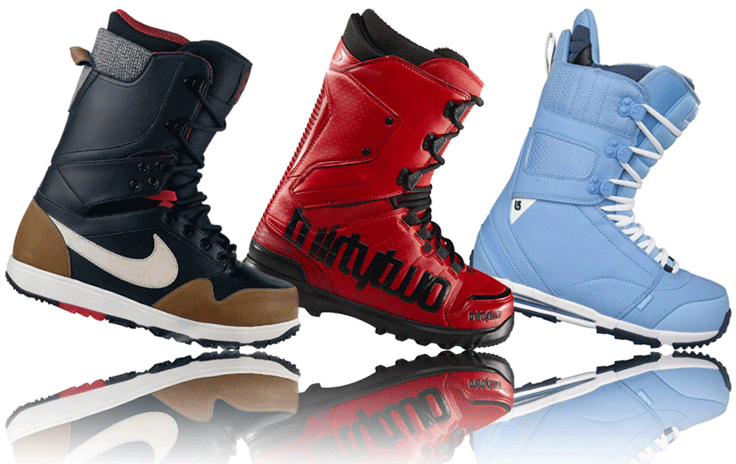
Traditional Lacing
Dating back further than Ötzi the Iceman, traditional laces are the tried and true option for your prototypical rider. By tightening your boots by hand, traditional laces offer the most customizable fit among the different lacing styles. Although easy to use, traditional laces can be difficult on your hands in harsh winter weather and can often loosen during the day. Despite this, many snowboarders stick with this classic system for easy lace replacement and a tailor-made fit.
|
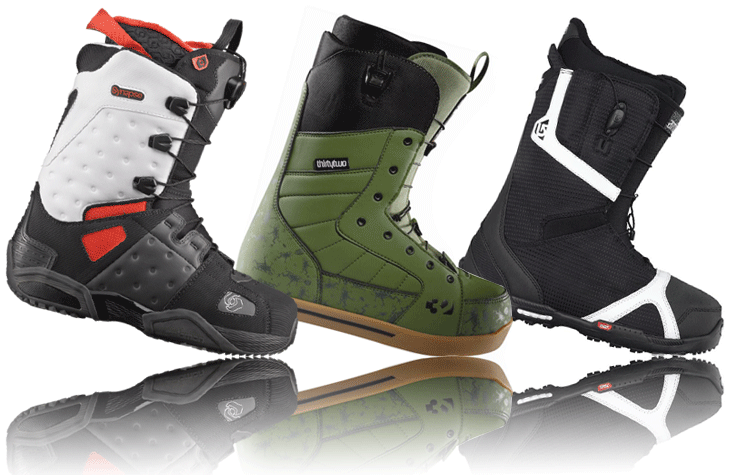
Quick-Pull Lacing
Faster than traditional lacing systems. Many quick-pull lacing systems allow the forefoot and ankle/lower leg to tighten independently from each other, this is called zonal lacing. This type of lacing system is fast, easy, and can be tightened while wearing gloves. There are many different types of quick-pull lacing systems that vary from company to company.
|
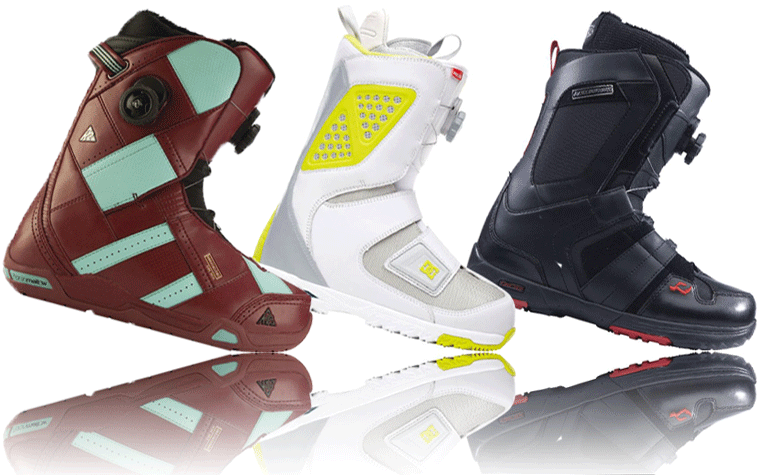
Boa® Lacing
Boa® lacing systems offer fast and easy micro adjustability to your boot fit. Boa® systems use a ratcheting dial attached to a cable. The turning and locking can be done with one hand and also with gloves on. Boa® closures are often offered as a double or even triple system, with one dial controlling the forefoot tightness and one or two controlling the upper cuff tightness.
Up to 60% OFF on Nike Apparel & Shoes at 6pm. Discover more discounts with 6PM shoes coupon and coupon codes in 2016!
|

No comments:
Post a Comment